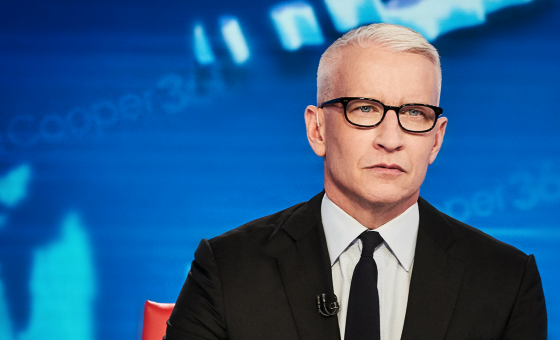

CNN’s Anderson Cooper traveled to South Africa to fact-check President Donald Trump’s explosive claim that white farmers are facing genocide. What he delivered instead was a tightly packaged 15-minute segment on “60 Minutes” that pushed back on Trump’s language — while leaving major allegations hanging in the air.
Cooper made it clear from the start why he was there: Trump had accused South African President Cyril Ramaphosa of being complicit in what he called the “genocide” of white farmers. In a tense Oval Office exchange months earlier, Trump even played footage of Julius Malema, leader of a radical black nationalist party, chanting “Kill the Boer, kill the farmer” before thousands of supporters.
Ramaphosa flatly denied the genocide accusation.
Cooper set out to test Trump’s claims. He highlighted one of the most viral images Trump referenced — a long stretch of road lined with white crosses, which Trump described as burial sites for more than a thousand murdered white farmers. When Cooper visited the location, the crosses were gone. The rancher who placed them there, Daryl Brown, explained they were a temporary memorial honoring fallen farmers, not actual graves.
A former South African schoolteacher, Anet Coetzee, woke up to a double-barrel shotgun shoved through her window. She only had time to cry out to God before the blast tore through her face and arm, knocking her to the floor.
She lost her right eye and most of her teeth that… pic.twitter.com/3RC3AHMRgN
— Derek VanBuskirk (@DerekVBK) June 5, 2025
That revelation undercut Trump’s specific claim. But it did not erase the violence those crosses symbolized.
Cooper emphasized that South Africa faces staggering crime overall. Police estimate more than 25,000 murders nationwide in 2024. Of those, 37 occurred on farms. He also cited early 2025 data showing that five of six farm homicide victims in the first quarter were black, suggesting the violence is not racially exclusive.
The broader message of the segment was clear: South Africa has a crime crisis, not a targeted racial extermination campaign.
But critics argue that framing leaves out uncomfortable details.
Multiple South Africans interviewed separately have described farm attacks that go beyond robbery. Survivors recount being tied up, tortured, beaten with tools, scalded with boiling water, and subjected to racial slurs. In some cases, attackers allegedly left without stealing valuables. Others point to political rhetoric — including repeated public chants of “Kill the Boer” — as evidence that at least some violence is racially charged.
Jacques Broodryk of AfriForum Community Safety put it bluntly: crime affects everyone in South Africa, but farm murders are the only crimes openly incited by political figures. He called the debate over the word “genocide” a distraction from a deeper horror.
“Real people are getting brutally murdered here,” he said. “It’s a semantics game.”
Even some Afrikaners interviewed by Cooper rejected the genocide label, saying Trump may have used the wrong word. One widow described the attacks as “opportunistic.” Others agreed the crisis stems from rampant criminality rather than coordinated ethnic cleansing.
Still, the political backdrop adds fuel to the fire.
Trump also accused the South African government of seizing white-owned farmland under the Expropriation Act of 2024. Cooper reported that the law — which allows the state in some cases to take property without compensation — has not yet been used.
That is technically accurate.
Yet farming leaders argue the pressure comes from other directions. Black Economic Empowerment laws, they say, make it nearly impossible for white family farmers to access loans or major contracts unless they surrender majority ownership. Squatting regulations further complicate matters, with landowners claiming they struggle to remove illegal settlements that appear on private property almost overnight.
Area around an upmarket Apartment Complex.
Bryanston, Johannesburg, South Africa.
2022 to 2025. pic.twitter.com/pRu86HGfOS
— Jozi vs Jozi (@jozivsjozi) February 14, 2026
The white population in South Africa has dropped from 11 percent in 1996 to 7.3 percent in 2022. Afrikaners, descendants of Dutch settlers, now find themselves a shrinking minority in a nation still grappling with the long shadow of apartheid.
Cooper’s report landed where many establishment outlets have landed: rejecting Trump’s genocide claim while acknowledging a brutal crime wave. But for families who have endured violent farm attacks — whether categorized as racial targeting or opportunistic crime — the distinction may feel academic.
The debate now stretches far beyond a television segment. It sits at the intersection of race, crime, land reform, and political rhetoric in one of the world’s most volatile democracies.
And as Washington and Pretoria spar over words, South Africans continue to live with the consequences.