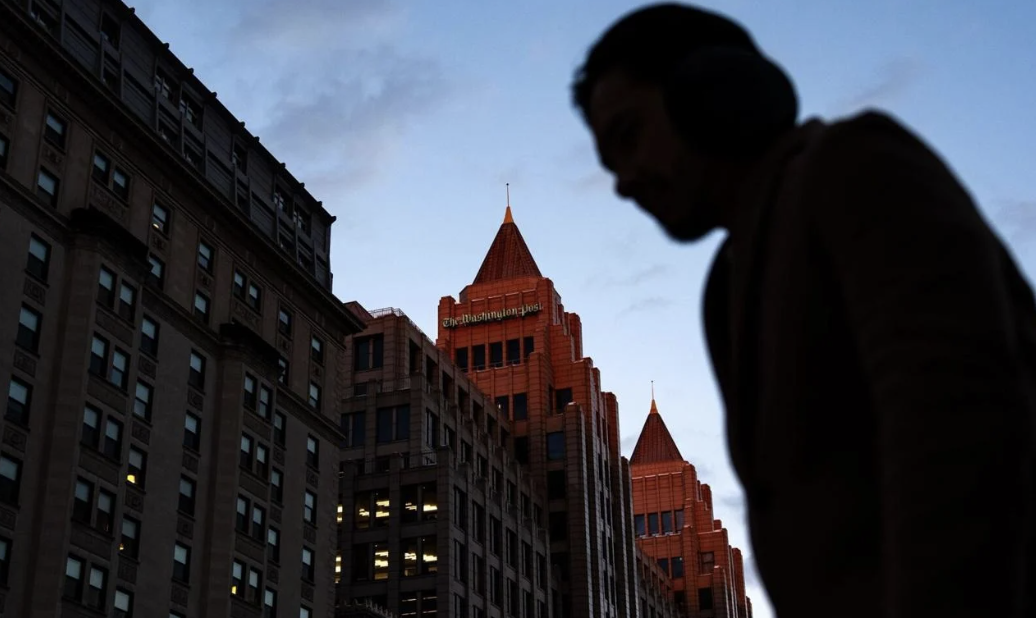

The Washington Post is bracing for a sweeping collapse inside its newsroom as leadership prepares to announce mass layoffs Wednesday morning, a move that sources say will eliminate roughly one-third of the company’s workforce and fundamentally reshape one of America’s most storied newspapers.
In an early-morning email, Executive Editor Matt Murray and human resources chief Wayne Connell told employees to stay home and log on for an 8:30 a.m. ET Zoom meeting, where “significant actions across the company” will be unveiled. Behind the vague language, the reality is far more severe.
According to sources inside the paper, the Post is effectively shutting down its Sports section, closing the Books section entirely, and canceling its daily Post Reports podcast. The Metro desk — long responsible for coverage of Washington, D.C., Maryland, and Virginia — will undergo a major restructuring that insiders describe as one of the deepest cuts in the paper’s history. International coverage is also being slashed, with multiple foreign bureaus closing or downsizing, though a handful will remain open.
The layoffs have been anticipated for weeks. Tensions escalated after leadership quietly informed staff that no reporters would be sent to cover the Winter Olympics this month, a decision that sparked outrage inside the newsroom before being partially reversed. That episode only reinforced the sense that the Post was in retreat.
Publisher Will Lewis has privately told colleagues that the paper must find a path back to profitability by narrowing its focus, prioritizing politics and a limited set of core areas while pulling back from sports, books, and large swaths of foreign reporting. That strategy alarmed journalists across the newsroom, prompting multiple letters to owner Jeff Bezos urging him not to hollow out the institution.
Washington Post announces widespread layoffs, gutting numerous parts of its newsroom https://t.co/lsbIYRFVI7
— Media Financial Mgmt (@MediaFinance) February 4, 2026
One letter, obtained by CNN and signed by White House bureau chief Matt Viser and seven other reporters, warned that even political coverage — the Post’s crown jewel — would suffer if other sections were gutted.
“If the plan, to the extent there is one, is to reorient around politics,” the reporters wrote, “we wanted to emphasize how much we rely on collaboration with foreign, sports, local — the entire paper, really. And if other sections are diminished, we all are.”
The upheaval follows a turbulent year tied closely to Bezos’ influence. Last year, Bezos announced a dramatic shift in the paper’s opinion section toward libertarian principles such as free markets and personal liberty, a move that led opinion editor David Shipley to resign. Months later, Bezos personally canceled a planned editorial endorsement of then–Vice President Kamala Harris ahead of the 2024 election. That decision triggered a wave of subscriber cancellations and dealt a significant blow to the Post’s finances.
Inside and outside the newsroom, many journalists now believe the cuts go beyond economics. Some see them as part of Bezos’ effort to reduce political risk amid his and Amazon’s complicated relationship with President Donald Trump and his administration.
“Bezos is not trying to save The Washington Post,” former Post fact-checker Glenn Kessler wrote this week. “He’s trying to survive Donald Trump.”
Former executive editor Marty Baron, who led the paper through its Pulitzer-winning Trump-era investigations before retiring in 2021, issued a stark assessment of the moment.
“This ranks among the darkest days in the history of one of the world’s greatest news organizations,” Baron said. While acknowledging real business challenges, he argued the crisis was compounded by leadership decisions. “The Post’s challenges were made infinitely worse by ill-conceived decisions that came from the very top.”
As staff log onto Zoom Wednesday morning, many already believe the damage is irreversible. What emerges on the other side may still bear the Washington Post name — but insiders say it will be a far smaller, narrower, and less influential institution than the one that once defined American journalism.